Utilising the Power of the Hive Mind to Drive Social Improvement

Dr Huw Davies
Chief Operating Officer
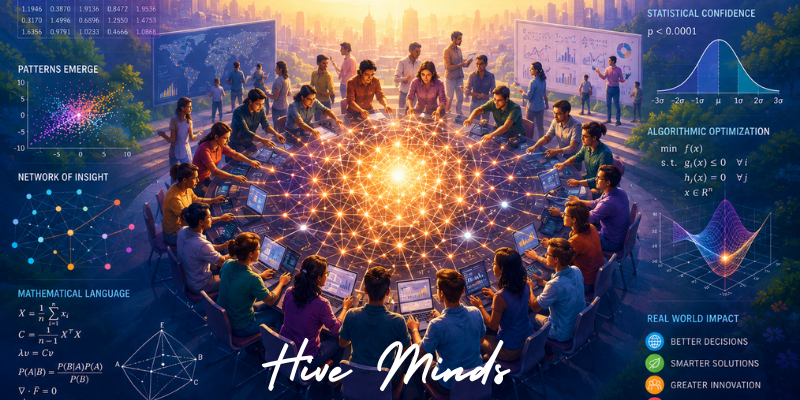
Gestalt theory is something that most of us subscribe to in an almost a priori way. The notion that the whole is greater than the sum of its parts makes sense. Indeed, it wasn't until humans began to work together through agriculture that we formed meaningful societies (those beyond the immediate family group). But this "togetherness" (to take it out of its native German) appears in many forms throughout the world, so if we are to best replicate it for societal advancements, how should we do it?
Let us first consider the "Hive Mind" of insects such as bees and ants. These creatures live in incredibly complex societies where each member has a distinct role. Ants may be incredibly strong creatures but I don't think anyone would argue that their intellect is sufficient to consciously create the society that it has (forgive the anthropomorphic use of "society"). It seems fairly obvious to any Darwinian that these roles have been evolved. Those groups of ants who happened to assume certain roles in a certain way prospered, those that didn't, well, didn't.
The same may be said about honeybees who will gather their stores at the smell of smoke to ensure the queen has enough resource to continue the development of the hive, making them docile enough for the beekeeper to gather their delicious product. Despite this being the very definition of the hive mind, the application of such a methodology to innovation appears obtuse at best.
But what of the murmuration of birds? This spectacle looks so much like its own entity that it is hard to think of the flock in anything other than a single conscious state. This is, of course, contrary to Occam's razor. It is, perhaps, far more likely that the reflex of birds is so much faster than we would conceive, as any farmer who has chase an errant chicken around their farmyard would tell you. The swallow is simply practicing for their great migration. Learning how to fly and adapt together to ensure greatest efficiency.
One moves, all move, in a mesmerising pattern in the sky.
So far we have seen that all these groups who demonstrate a hive mind do so with a common purpose. However, the murmuration has a more reactive sense to it. Almost as though they understand what their fellow birds are doing, or will do.
This leads me, as do most things, to consider the beautiful sport of rugby (one might be able to substitute football, or hockey, or any other traditional team sport if one really had to). The closeness of players in all great teams is no coincidence. Drills are not learning a skill but learning how our teammates execute that skill.
Commentators marvel at the 'no look pass' when the passer of the ball throws the ball into a space without looking where it is going.
Just as the murmuration moves in unison, so the close team of rugby players recognise a pattern of behaviour in their teammates and know that there will be space on the outside or that they glimpsed their comrade in arms running laterally behind their back. It's not witchcraft – it's understanding.
This leads me on to my recent research in mitigating misunderstanding in the NHS through shared experience. The research demonstrated that where two parties were able to share the experience of a problem, even if that shared experience was just in a room discussing the problem, miscommunication / misunderstanding fell by over 80%. If applied to the work of the Analyst and, moreover, the required remediation work required from miscommunication / misunderstanding (yes, they are the same thing told from two perspectives but the communication implicature relies on both parties to communicate and understand in equal part).
The greatest sports teams spend hours and hours each day, encountering these problems and sharing an understanding as to their potential solutions. They begin to see how each person will react in a slightly different way, much like the swallows might. They will use this knowledge, often subconsciously to protect the ball (or queen) to ensure that the colony is victorious.
However, this gamification appears to be outside to domain of innovation in health and care, but is it?
The Data Observatory for Health and Social Care is committed to being the country's leading think tank on health data and wider determinants. To bring gestalt theory to play in the most meaningful way possible: positive outcomes for patients. As the population ages and requires more healthcare, whilst budgets are cut, we are reaching a point of critical mass upon which services can no longer be sustained in their current format. The success of health and social care in the UK (no, really) has resulted in this impasse.
We need the hive mind of the most astute data and analytics professionals to use evidence and research to formulate a better way, current thinking may be that strategic commissioning based on value outcomes is more relevant than paying simply for activity, but that is another story. We need the best minds working together to become greater than the sum of its parts in order to reverse the trend of more sickness and less resource.
It is not possible to just ask these data leaders to consider a problem and navel gaze until something comes up, they are far too busy. We need a solution that creates that team of subconscious understanding. Where familiarity in each other's play making ability enables us to loop around the outside and catch a ball that wouldn't have been passed in any other circumstance.
The Data Observatory has a Council of Senior Advisors. Fifty of the country's finest data professionals with skills ranging from architecture, governance, AI, ethics, population health management, economics and so much more. This is the team. To create the familiarity over a round table discussion is not enough. As a result the Data Observatory will host a series of symposia to address specific issues in health and care, where the profoundly knowledgeable Senior Advisors will share the experience of a problem and understand the issues in the manner that is understood uniquely by everyone else in the room, even if only at a subconscious level. This will generate solutions far greater than the individuals in the room.
This is the hive mind. The quantum computing of problem solving.
No-one is suggesting this will be easy. It may take several days of discussion just to get to the root of an issue, but this is the only way we can step above our singular insight and adapt our thinking to be greater than our isolated thoughts. This is no longer an ambition, it is no longer even just a reality. This is a necessity, if we are to reverse the divergence of health and resource.
We have a series of issues that require attention and we are primed for our deep dive sessions, working together until the solution is found. We also welcome requests from outside the Observatory onto what else we might focus our togetherness on.
This isn't thought leadership, this is thought revolution.
We convene leading experts and scientists across health and social care to explore the ideas shaping the future of data.
Interested in partnering or collaborating on a topic? We would love to hear from you.